Enrico Pisino at the helm of Cluster Trasporti: innovation and AI at the center for the next three-years
Published 5 June 2026
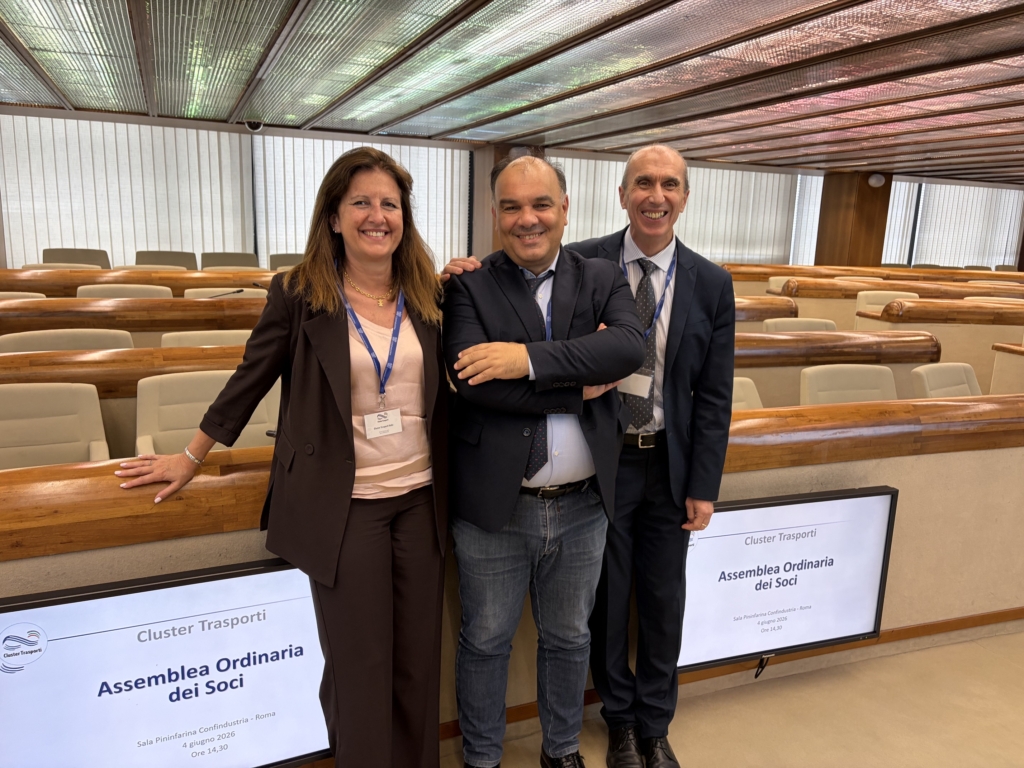
Pinned photo: in the center, the new president of the Cluster Trasporti Enrico Pisino, flanked by the Cluster’s secretary Antonella Trombetta and the Cluster Manager Piersandro Trevisan.
Enrico Pisino is the new president of Cluster Trasporti for the next three-year period. Currently CEO of the National Competence Center CIM, Pisino succeeds Professor Ennio Cascetta, who concluded his mandate after six years of activity. The appointment took place on June 4th in Rome, at the Pininfarina Room of Confindustria, during the ordinary shareholders’ assembly. The new presidency aims to proceed in the sign of continuity, aiming for ever greater integration between different modes of transport and new technological dimensions, with particular attention to issues relating to energy, data analysis, and artificial intelligence.
“It is necessary to work within the Cluster Trasporti so that logistics, critical infrastructures, and intermodality are at the center of the public and institutional debate on sustainable mobility. The technological trajectories, which we will define together with leading companies and Italian universities, must become the ingredients useful for defining policies that allow Italy and Europe to transform the mobility and logistics of people, goods, energy, and data into social and industrial development. It is therefore important, on one hand, to intensify the relationship with MIT, MIMIT, and MUR and, on the other hand, to enable the use of core digital technologies, primarily Artificial Intelligence, by the supply chains involved and by companies, both large and small. Furthermore, it is fundamental to structure a continuous dialogue with the best international interpreters of innovation in the transport system, primarily China and the United States,” stated Enrico Pisino.
The opening of the proceedings was entrusted to the greetings of the outgoing president, who retraced the profound transformation of the Cluster Trasporti, which over the course of the two three-year terms was able to adapt to a complex and constantly evolving international landscape. “We transferred our DNA, transforming ourselves from an entity that had to be a programmer of research funds to a provider of visions, studies, and analyses that were positively received by the institutions. In our country, a general perspective on the path to follow is often lacking; we managed to offer a third-party point of view compared to the individual interests of the sector’s players,” he explained during his greeting to the members.
The new president Enrico Pisino specified the course for the future in the name of continuity, highlighting the need to integrate new technological dimensions within the different transport modes. “The world of transport and logistics is evolving rapidly, and we must give the right weight to every area and sector. The airway, for example, we cannot neglect it; it is part of the transport world, just as the transport world is not only about people and goods in the strictest sense of the term, but also energy and data: factors that transversally influence all compartments of the sector, from roads to waterways. Artificial intelligence is also changing the rules of the game, and it is a commitment we must all take on, fueling thematic working groups and involving industry more, as the voice of those who must take the helm of strategic choices is fundamental,” he specified during his inauguration speech.
The assembly was also an occasion to highlight the new structure of the CISG (Strategic Steering and Management Committee), marked by changes to respond to the transport challenges of tomorrow. In addition to the rise of Enrico Pisino (CIM 4.0) to the presidency, the main innovations see the inclusion of new profiles in the various operational sectors. This is a revision that reflects the multidisciplinarity of the Cluster Trasporti across its four main industrial pillars. Fabrizia Vigo (ANFIA) and Ezio Spessa (Polito) enter the automotive sector. For the railway sector, the innovation is represented by Ugo Dibennardo (FS Engineering), while for waterways, Dario Bocchetti (ALIS) and Stefano Pagani (Confindustria Nautica) make their entry.
To guarantee operational continuity, the following remain full members of the Committee: Gabriele Vargiu (Iveco) and Raffaele Trivilino (IAM) for the automotive sector; Veronica Bocci (Ditecfer), Andrea Collina (Polimi), and Antonella Trombetta (Hitachi) for the railway sector; Alessandro Iafrati (CNR) and Katia Balducci (Navigo) for waterways. The Intelligent Systems (ITS) sector has undergone no changes, confirming Saverio Gaboardi (CLM), Angela Di Febbraro (Unige), Dario Ferrillo (Almaviva), and Nunzio Micalizzi (Leonardo).
The Scientific Council is also renewed with the entry of Angelo Bonfitto (Polito) in the rubber area, but at the same time maintains its solidity with the confirmation of coordinator Giampiero Mastinu (Polimi) for the ITS3 area. Historical members who preside over the various research areas remain firm in their roles: Francesco Leali (Unimore) for ITS; Nicolò Cavina (Unibo) for rubber; Andrea Rindi (Unifi) and Luigi Rucher (Hitachi) for rail; Paola Gualeni (Unige) and Alberto Marinò (Units) for waterways; Gennaro Bifulco (Unina) for the Training area.
Regarding upcoming activities, the agenda is full of technical and institutional commitments. A fixed point will be the support to members for access to MIMIT funding related to the automotive DPCM, a 1.3 billion euro tender that includes approximately 250 million specifically intended for “Innovation Agreements”. On the operational front, however, the Working Groups, will continue to produce technical reference documents. The “sea” group, for example, is working on a new Position Paper for the 2026-2028 Sea Plan, which will be at the center of an autumn workshop dedicated to sustainable fuels and digital technologies for navigation. At the same time, the “rail” group will focus on energy efficiency and the automation of control systems. The Cluster Trasporti also looks with determination to the Transport Research Arena (TRA) 2028, which will be held in Milan. This is the main European event on transport research, an occasion where the association will aim to showcase Italian excellence and consolidate dialogue with researchers, industry, institutions, and international stakeholders on models and technologies for the future of transport.
Associazione Cluster Trasporti Italia 2020
Viale Pasteur, 10 00144 Roma
TEL +39 06 54221493 (4)
FAX +39 06 54221418
CF 97794560587
EMAIL cluster.trasporti@anfia.it