Scenarios for logistics in Italy: innovation and intermodality at the heart of the Transport Cluster conference
Published 5 June 2026
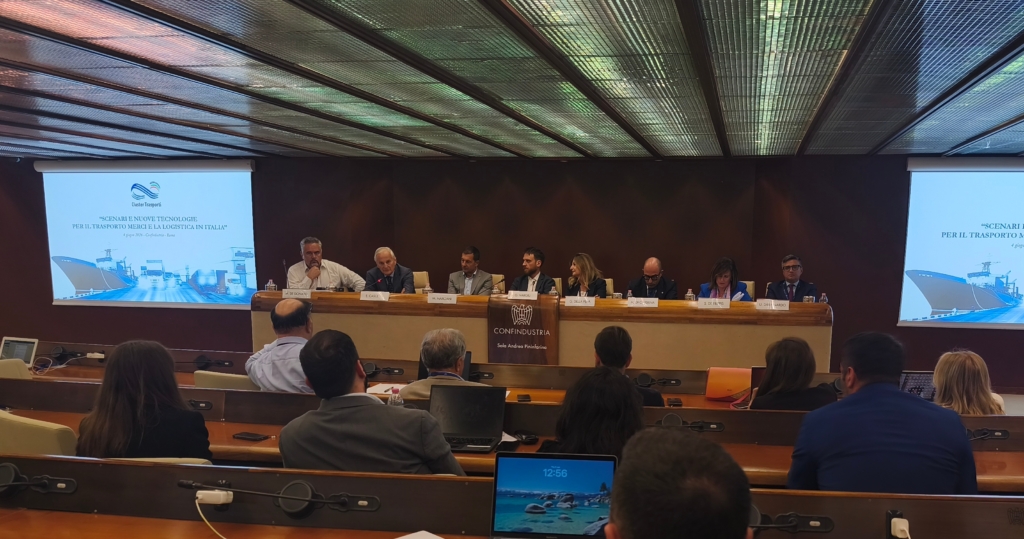
The evolution of logistics today finds its foundation in the integration of technological innovations, the pursuit of environmental sustainability, and the enhancement of infrastructural efficiency and intermodality. Precisely these directions animated the discussion held last June 4th in Rome, at the Confindustria headquarters, on the occasion of the Cluster Trasporti conference.
During the event, titled “Scenarios and new technologies for freight transport and logistics in Italy,” it emerged how the management of logistics chains today requires overcoming traditional paradigms to adapt to a global framework marked by geopolitical uncertainties and constant technological evolution. To preserve the resilience of the sector in all its modes, specifically, the sector must prefer a new organizational flexibility capable of responding to sudden and potentially disruptive changes.
The goal of the discussion was, in fact, to outline development perspectives for supply chain operators, analyzing the weight of innovations on current organizational models and laying the foundations for a collective future vision capable of responding to the challenges of an increasingly changing and disruptive global market.
Logistics in Italy: the scenario of the Cluster between uncertainty and innovation
During the opening of the works, Cluster Manager Piersandro Trevisan illustrated a detailed analysis conducted by the Cluster (link to the full document here), highlighting a framework dominated by geopolitical and regulatory instability. A significant passage of his report concerned the phenomenon of decoupling, namely the decade-long attempt to separate the trend of the Gross Domestic Product (GDP) from the increase in transport demand. In this regard, Trevisan showed how, in Italy, this objective remains complex: while GDP appears stagnant, road traffic continues to grow steadily, unlike the maritime and railway sectors which have suffered slowdowns.
Going into more detail, the report shows how the sector must today deal with challenging European objectives, such as the 90% cut in emissions for heavy vehicles by 2040, a goal that appears almost unreachable for the current industry. The fragility of the Italian system emerged strongly when looking at the Alpine passes, through which 65% of our exports transit, a flow that is today constantly threatened by construction sites and infrastructural limits.
In this context, intermodality emerges as a fundamental response to preserve the future of the sector, especially for long-range connections towards Northern Europe. A sector that in Italy is encountering temporary obstacles due to the massive presence of railway construction sites, which extend transit times and complicate flow management. Another criticality is linked to the national network of interports which, although counting 24 structures, suffers from an unbalanced geographical distribution that limits its effectiveness in the Center-South.
On the technological front, Trevisan cited “truck platooning” on the roads and the use of “digital twins” in ports as some of the concrete solutions to improve efficiency and reduce unproductive movements.
An eco-rational approach for the future of transport
In light of this scenario, Ennio Cascetta invited those present to a deep reflection on the perception of change, urging them to definitively abandon the expectation of stability similar to that of past decades. The outgoing president of the Cluster Trasporti highlighted how the current landscape is characterized by a double uncertainty: on one hand, external variables linked to conflicts and fluctuations in energy costs, and on the other, a technological evolution that no longer proceeds linearly, but through sudden and radical leaps forward.
To corroborate this thesis, he cited the very rapid rise of electric heavy vehicles, once considered a distant prospect, and the multi-billion dollar investments that global giants are pouring into autonomous driving, now perceived as an imminent goal. In this scenario, companies must learn to promptly integrate digital innovations, from carbon footprint reporting systems to tools for the intelligent organization of fleets, in order not to remain anchored to obsolete models.
Precisely on this point, Cascetta underlined the need for a cultural change even before an operational one, recalling that “this myth that we all have a bit of a return to normality, to habit, to what we have always done with a bit of effort, must be overcome” in order to correctly interpret the dynamics of the future. At the center of his vision, the principle of eco-rationality clearly emerges, an approach that invites pursuing environmental goals with pragmatism, weighing every choice based on real technological and economic feasibility.
The topics addressed during the round table
The heart of the meeting got into full swing with the round table moderated by journalist Massimo De Donato, which compared the different protagonists of the supply chain to analyze structural criticalities and opportunities for integration between infrastructure, road, rail, and sea.
The president of the PIARC Italy Technical Committee, Massimo Marciani, opened the discussion by focusing on the management of road networks, highlighting how Italy’s enormous infrastructural heritage suffers from fragmented governance among as many as eight thousand different entities, making coordinated planning of the first and last mile difficult. For Marciani, infrastructure must be considered an enabling platform for complex services, clearly explaining that “infrastructure is the hardware that can enable a software” more complex: that of transport.
The challenges of heavy road transport were explored in depth by Gabriele Vargiu, Public affairs & Sustainability of IVECO, who pointed out a worrying distance between European legislative ambitions and the actual purchasing dynamics of electric vehicles. In this regard, Vargiu cited the Salini report as a possible way for a more reasonable transition, emphasizing that “we are in the decisive months for the definition of the revision of the regulation”.
At the same time, Giuseppina Della Pepa, general secretary of ANITA, analyzed the structure of the sector, composed almost entirely of small businesses, where only 2% have a significant fleet for moving goods. Looking to the future, Della Pepa highlighted that “the real challenge is to ensure that these technologies can be adopted on a large scale, because otherwise we will continue to have a sector that goes at two speeds”. In addition to the technique, Della Pepa called attention to the need for legislative stability that allows companies to invest with confidence, while at the same time valuing the professional skills of workers in this delicate phase of transition.
The maritime sector was instead represented by Marcello Di Caterina, vice president and general manager of ALIS, who expressed strong fears for the new European ETS taxes, capable of penalizing national ports in favor of non-EU ports. Di Caterina defended the economic value of the maritime chain, calling for policies that do not sacrifice competitiveness in the name of abstract environmental goals.
The railway sector was analyzed by Ugo Dibennardo, Strategy and Planning Direction at FS Engineering, and Sabrina De Filippis, CEO and General Manager of FS Logistix. While Dibennardo illustrated FS Engineering’s commitment to designing resilient networks that put freight and passengers on the same level, reiterating that “logistics must be seen in a univocal way”; De Filippis instead underlined the importance of the cultural revolution, highlighting the value of new digital platforms and urban logistics for the modernization of the sector.
Logistics as a pillar for stability and social cohesion
In the concluding reflections, Ennio Cascetta reiterated that the movement of goods is an essential service that guarantees the very survival of society. Without an efficient logistics system, stocks of primary goods would run out in less than a week, causing the collapse of daily activities. The outgoing president urged politics to base decisions on objective data and scientific analysis, avoiding purely ideological approaches that do not take into account the global reality of emissions. His final message was clear and direct: “logistics is that activity that keeps us five days from famine”.
Associazione Cluster Trasporti Italia 2020
Viale Pasteur, 10 00144 Roma
TEL +39 06 54221493 (4)
FAX +39 06 54221418
CF 97794560587
EMAIL cluster.trasporti@anfia.it